
Referrals
Running together is better. Let runners bring their friends, and see who brought whom
Most people enter a race because a friend asked, their running group picked it, or someone they follow is going. Yet all you see is the total entry count, not who brought those people in.
Thanking or rewarding the runners who recruited comes down to hearsay, and influencers get paid on follower count rather than entries. So the ad budget goes on finding strangers, when the easiest people to reach are the friends of runners who have already entered.
A personal invite link for each runner shows you who brought whom, lets you reward on real numbers, and costs nothing per head.
What this service does for you
- 1
A runner names their team and gets one link
They can start from the event page or straight after entering, and name the team in Thai or English. The system issues a link immediately in the form /[event]/team/[team name], ready to share in a LINE group or on social — where it unfurls into a preview card with the event image and the team name.
- 2
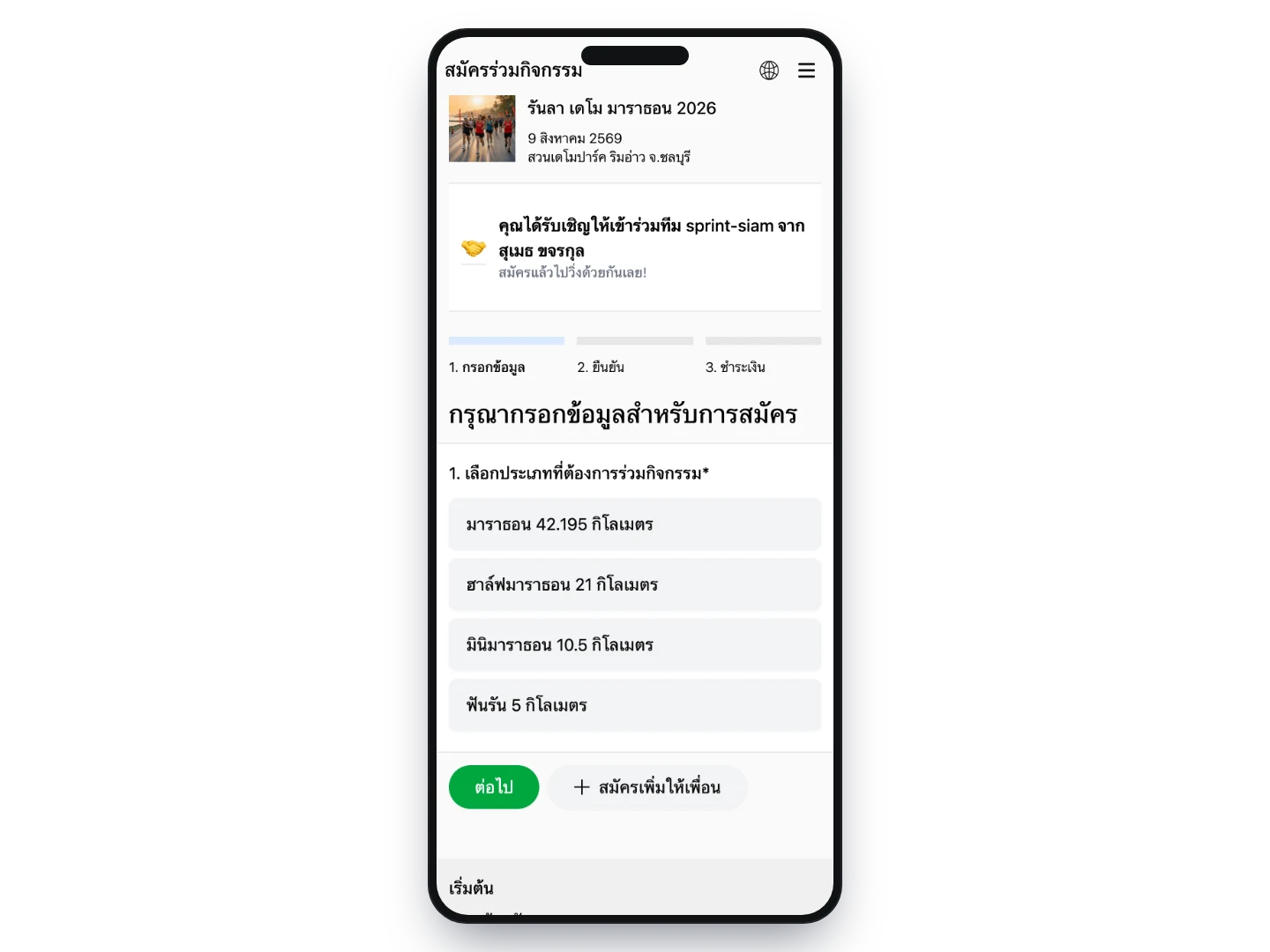
Friends who open it see who invited them
The entry page carries a banner naming the team and the person who invited them, which is usually the actual reason they go on to enter — not an advertisement, but knowing that someone they know will be there.
- 3
Attribution is tracked without touching the money
Someone who opens the link and enters later still counts toward that team for up to 30 days. Attribution is kept entirely separate from billing, so what you receive per entry does not change no matter how much referring goes on.
- 4
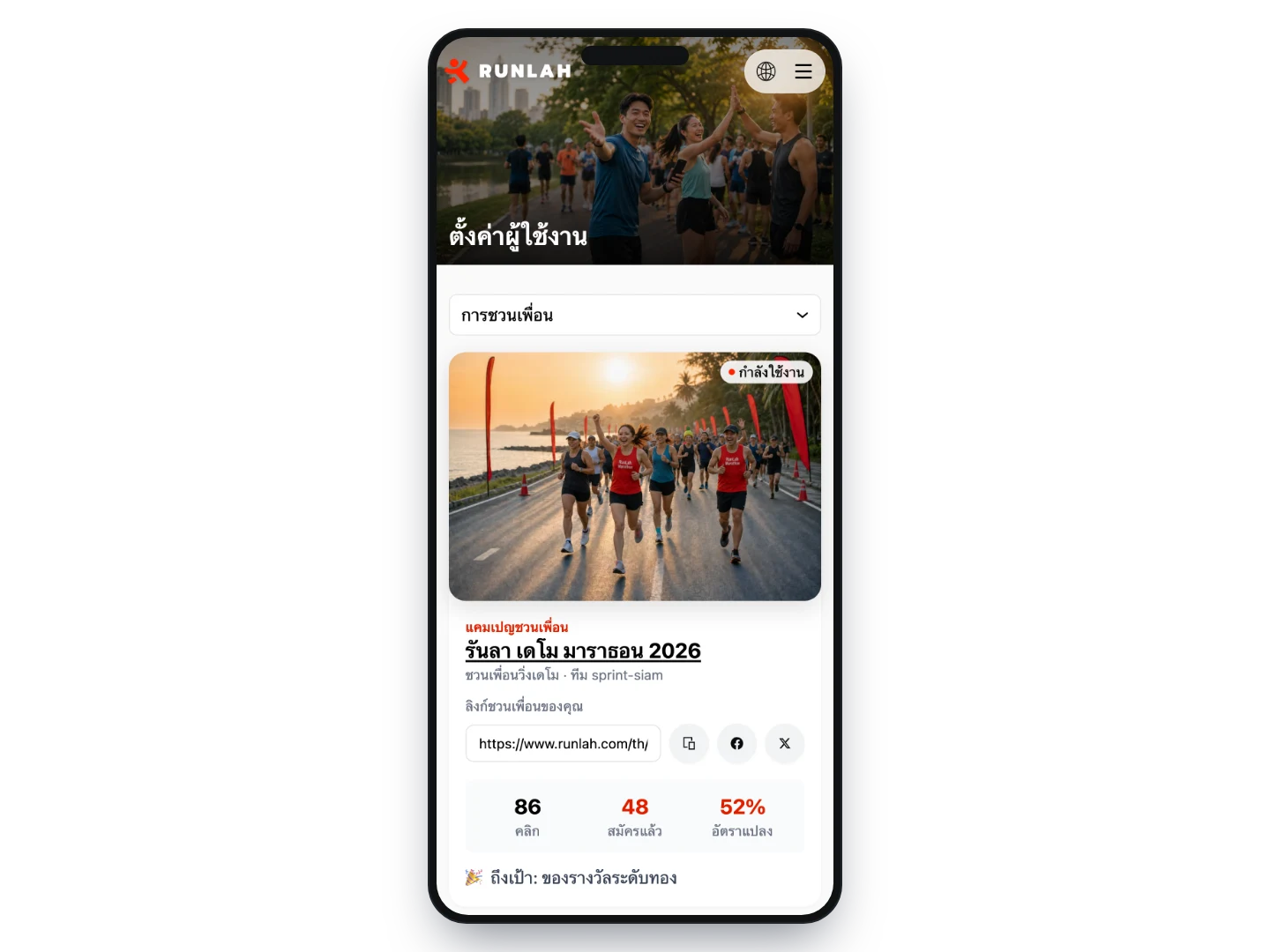
Runners can see how they are doing
Their own page shows how many times the link was opened, how many people actually entered, the conversion rate, and how many more are needed to reach the next reward. Seeing the numbers move is what keeps people sharing.
- 5
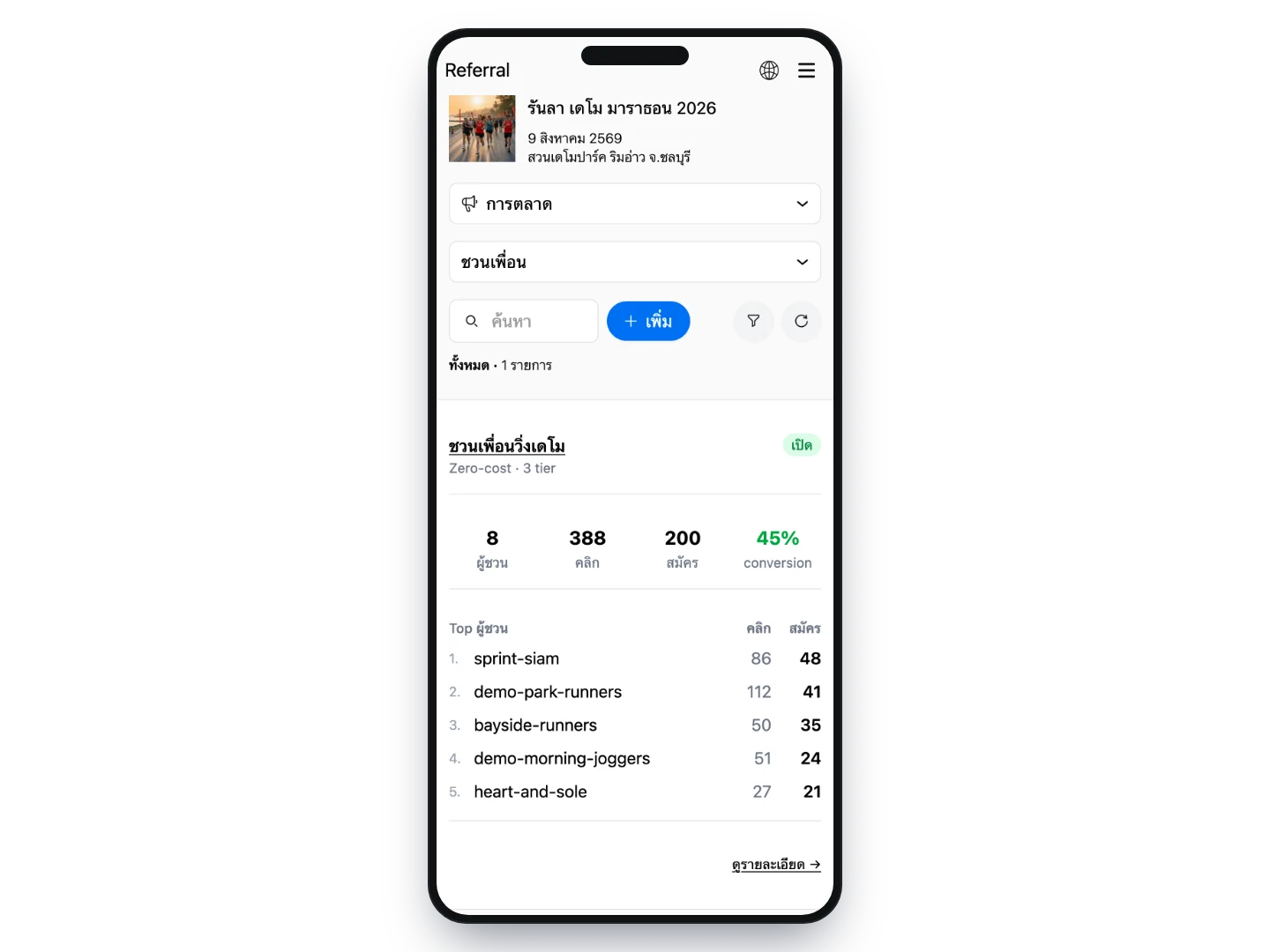
You see the leaderboard and award what you promised
The back office totals recruiters, clicks, confirmed entries and who is at the top. It settles rewards without relying on anyone’s word, and gives you real figures to negotiate with influencers next time.
How organizers use it
Come as a crew
A race is more fun with a group, so runners who have already entered have their own reason to bring others. All the system does is make it easy and make the effect visible — create a team, share the link, watch the number move.
Reward recruiters by headcount
Set the tiers in advance: a special souvenir at five, a free entry next year at ten. The rewards are yours to define and to hand out, so the cost stays fully under your control and nothing is taken off entry revenue you have already banked.
Measure influencers on entries, not followers
Give each of them their own link and compare directly how many entrants each brought in, rather than judging by likes or follower counts. Next season you know who to work with again and what they are actually worth.
Let clubs and running groups compete
Each club creates its own team and recruits its members, and the shared leaderboard becomes a contest before the race itself — which lifts entries through the flat middle stretch that is usually the quietest.
Let sponsors and companies distribute their places
An organisation given a block of places uses its own link to recruit staff, so you can see how many of those places were actually taken — a number worth having when the contract comes up next year.
Find out which channels work
Conversion per link shows who gets a lot of clicks and few entries, and who gets few clicks but converts nearly all of them. Those two need very different support, and neither is visible in the event’s overall totals.
What you can set
- Personal links
- Team names chosen by the runner in Thai or English, 2–30 characters, unique within the event
- Attribution
- Held in a cookie for 30 days, so someone who returns to enter later still counts
- Figures shown
- Clicks, confirmed entries and conversion rate — to the runner and to the organizer
- What counts
- Only entries that are paid or otherwise confirmed
- Reward tiers
- Multiple tiers by number of people recruited, with your own reward labels in Thai and English
- Cost per head
- None. The system does not touch entry fees; rewards are defined and given by the organizer
- When shared
- The link unfurls with the event image and team name on social and in chat apps
- Back office
- View the recruiter leaderboard, switch the campaign on or off, and remove unsuitable teams
Frequently asked questions
What does this cost the organizer?
Nothing per head. The system only records where an entry came from and has no bearing on the entry fee. Rewards are entirely yours to set — a souvenir, a free entry next year, or no reward at all if you would rather just use the leaderboard.
Can recruiters get an automatic discount?
Not yet. Today the system only tracks attribution; it is not connected to checkout pricing. If you want to give a discount, the practical way is to issue discount codes to the recruiters who hit your targets, based on the leaderboard.
Who gets credit if a friend opens the link and enters a week later?
That team still does — attribution is held for 30 days. If someone opened links from several teams, the most recent one counts. And when a runner who has already entered creates their own team, they are counted into it as well.
Is "recruited 10" counted as people or as entries?
As people. One entry covering three people counts as three. Conversion, on the other hand, is entries divided by clicks — deliberately a different unit.
What if someone creates a team with an inappropriate name?
You can delete teams from the back office. Teams with no entries through the link can be removed immediately; for teams that already have entries, tell us so the attribution for those entrants is tidied up at the same time.
Related services
Online registration
Our team reviews your details and configures the whole registration — distances, price tiers, caps, solo and team entries, event-specific questions — before you go on sale, and one set of entrant data carries all the way through to race day.
Promotions & discount codes
Set up discount codes, early-bird pricing or group rates, then see exactly how much of each code was used — so you can move sign-ups when you need to, on your terms.
Race statistics & analysis
Who actually ran, who did not turn up, when finishers arrived in the biggest numbers, and how long each distance took — read straight off your own race results, with nobody having to build a summary file.