
Online payments
Take money the way runners actually pay, including bank transfer with no service fee
A system that only takes cards loses runners at the payment page. Some have no card, some do not want to pay the extra fee, and they quietly close the tab.
Accept transfers and the work moves to your team: opening slips one by one, matching amounts to names, answering "did my money arrive?" in chat. At closing you still cannot be sure the numbers are right, with short payments, transfers nobody reported and entries whose status nobody knows.
With RunLah, runners choose PromptPay, card, or bank transfer with no service fee. Our team checks the slips and confirms entries, and you see sales, fees and net balance on one page.
What this service does for you
- 1
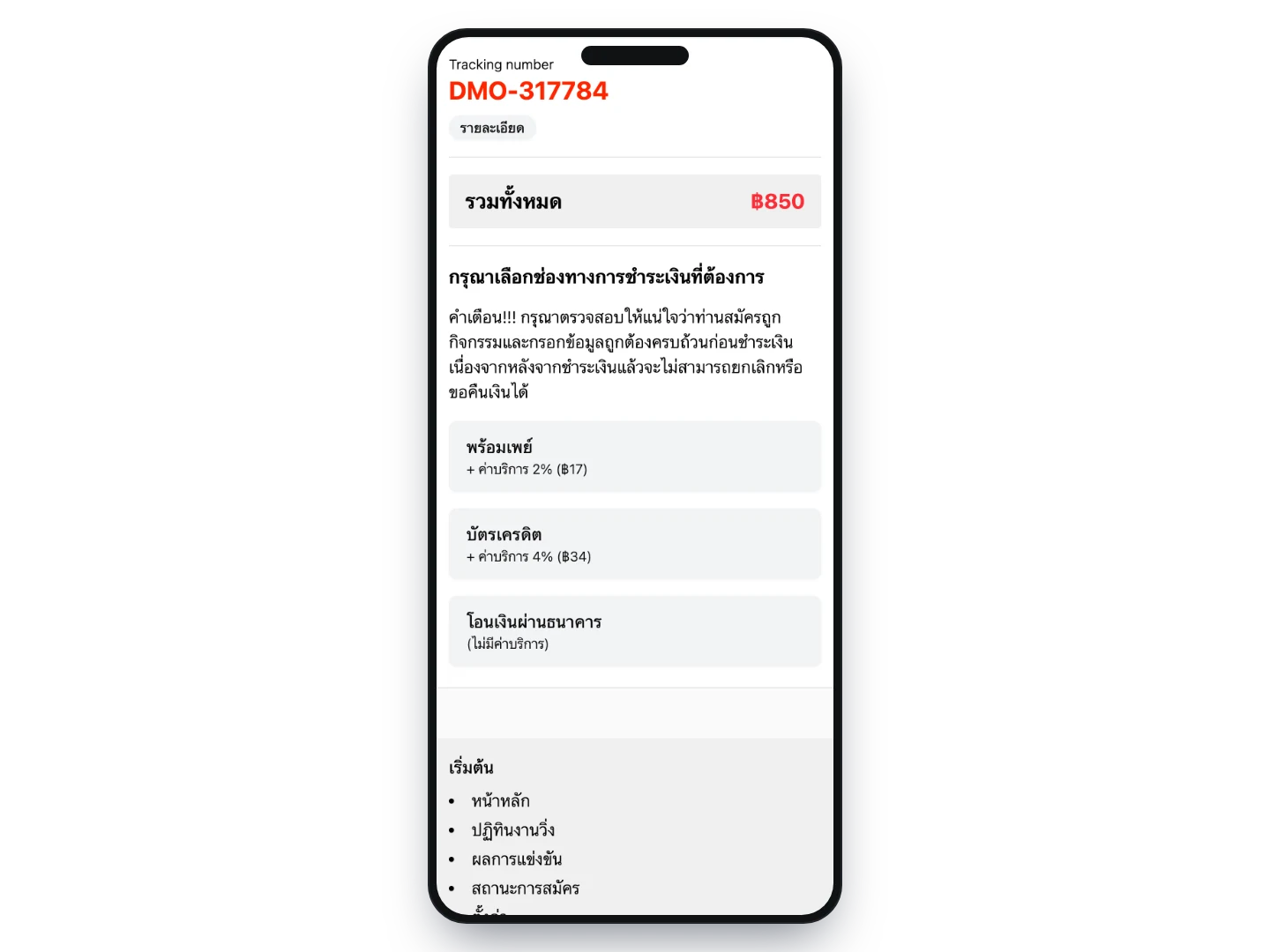
Runners pick the method that suits them, with the fee shown up front
The payment page lists every method with its actual fee as a number — not as small print at the bottom. Anyone who would rather not pay a fee can choose bank transfer, which carries none.
- 2
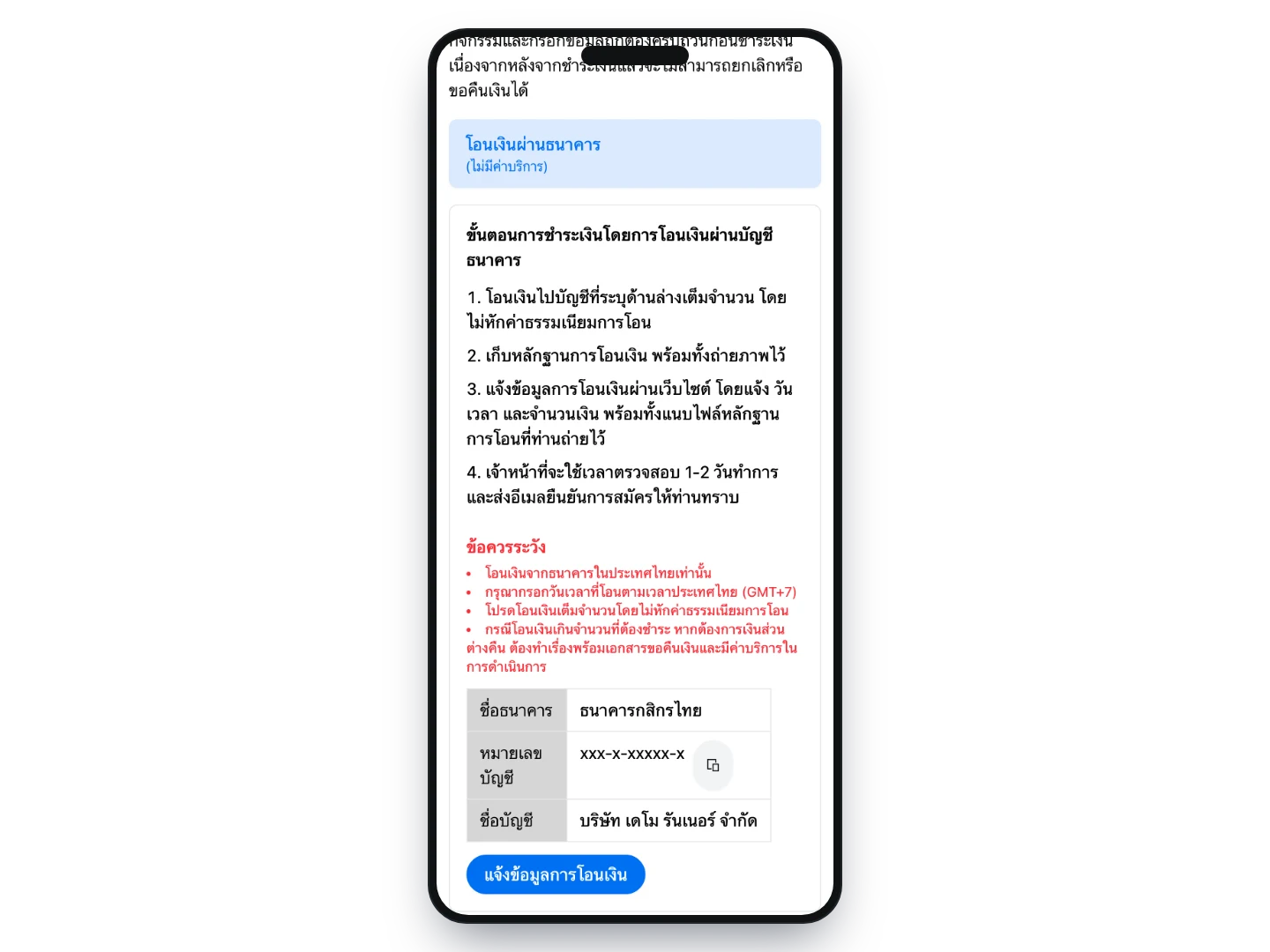
Transfers are reported on the site, not sent to a chat
The steps are spelled out: transfer the full amount, keep the evidence, then report the date, time and amount and attach the slip. The evidence stays attached to that entry instead of scattered through one staff member’s LINE history.
- 3
Our team checks the slips and confirms
Checking slips and replying to runners is our job, and takes one to two working days, after which the system sends the confirmation email itself. Nobody on your side has to watch a bank account or answer questions about whether money has arrived.
- 4
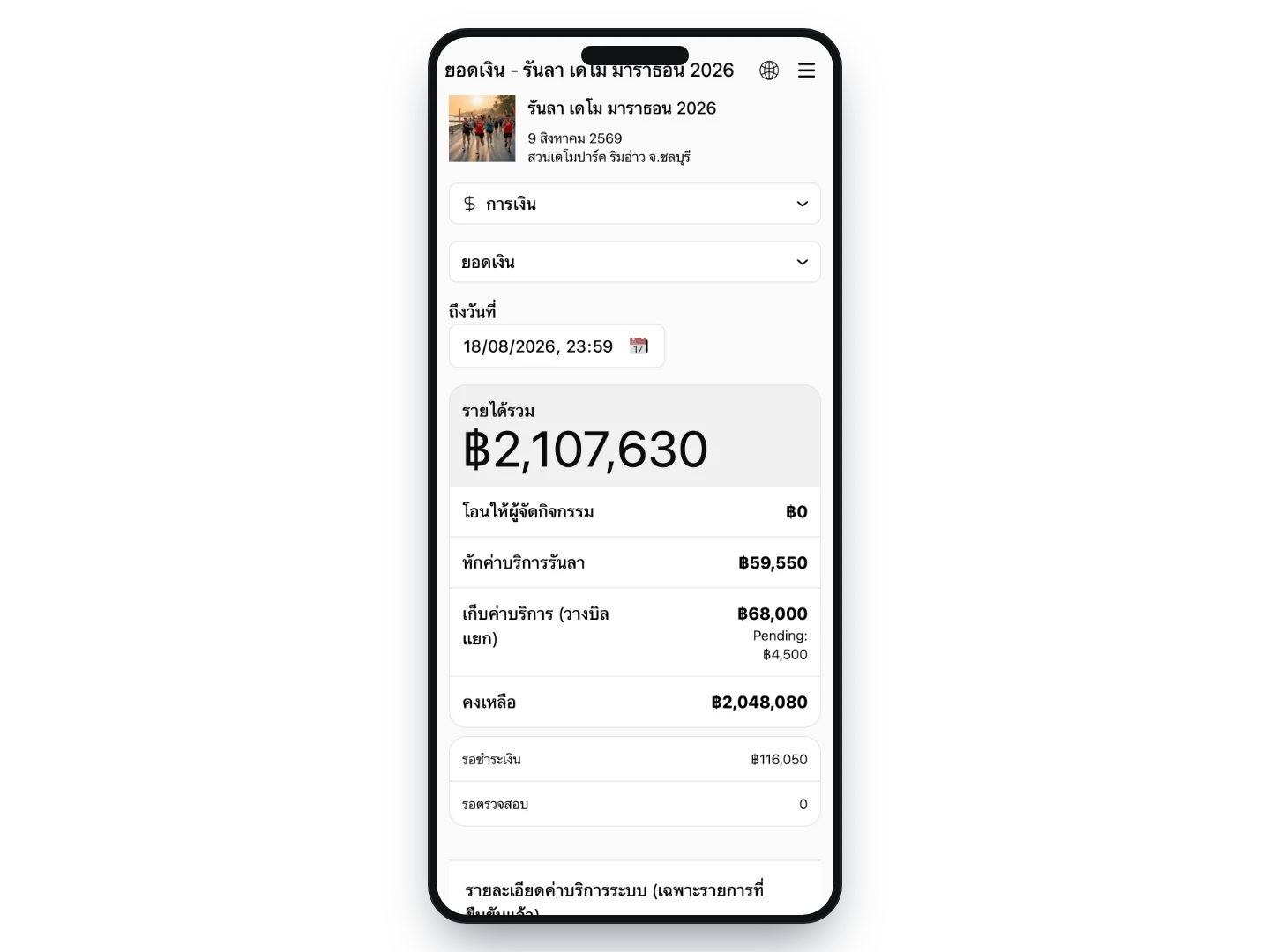
Sales, fees and net balance in one place
The event’s finance page shows what was sold, which fees were deducted and what you will actually receive, traceable down to the individual entry — with no totalling up from several piles of slips.
How organizers use it
Runners without a credit card
This group is real and not small, particularly at provincial races and events with many older participants. Transfers and PromptPay let them complete an entry themselves rather than asking a younger relative to pay for them.
People who do not want to pay an extra fee
Card and PromptPay fees are money on top of the entry price, and some runners will put the decision off because of it. Having a method with no fee removes that reason — which is why we make bank transfer available on every event at no charge.
Groups entering together on one transfer
Clubs and groups of friends who pool the money for several entries find a transfer easier than a card, and a large amount on a card is more likely to hit a limit or be declined.
Companies paying under their own procedures
Organisations sending staff usually pay from a company account and need paperwork to go with it. A transfer handles that directly, with nobody having to front the money on a personal card.
Events removing friction in the final stretch
The days before entries close are when runners decide fastest, so every obstacle on the payment page is revenue lost. Letting people choose their own method affects the final total more than most organizers expect.
What you can set
- Methods available
- PromptPay, credit and debit cards, bank transfer, and counter service — enabled to suit each event
- Bank transfer
- No service fee; enabled by default on every event
- Fees on other methods
- Set as a percentage per method per event, and shown to the runner as an actual amount before they choose
- Reporting a transfer
- Date, time, amount and an attached slip submitted on the site, tied to that entry
- Verification
- Done by the RunLah team within one to two working days, followed by an automatic confirmation email
- Unpaid entries
- Cleared automatically, so places are not held indefinitely by entries nobody paid for
- Organizer finance page
- Sales, fees broken down by method, and the net balance due to you, traceable to individual entries
Frequently asked questions
Is bank transfer genuinely free of charge?
Yes. We charge nothing on transfers, so the runner pays exactly the entry fee. Methods that run through a payment gateway, such as cards and PromptPay, carry the provider’s own fee, which is charged at cost and always shown before the runner chooses.
If we accept transfers, who checks the slips?
We do — it is not a job you have to staff. Runners report the transfer and attach the slip on the site, our team verifies it within one to two working days, and the system sends the confirmation email. You can see the status of every entry: confirmed, or awaiting verification.
What happens if someone transfers without telling us, or pays too little?
The entry stays in awaiting-payment until it can be matched, and the team follows it up from whatever evidence exists. If the amount was short, the runner is contacted to pay the difference.
Can we enable only some of the methods?
Yes, they are switched on and off per method per event. Some events run PromptPay and transfer only; others add cards to serve international entrants. Tell the team which combination you want.
When does the money reach the organizer’s account?
Sales and the outstanding balance are visible at any time on the event’s finance page. The payout schedule itself follows the agreement for your event.
Related services
Online registration
Our team reviews your details and configures the whole registration — distances, price tiers, caps, solo and team entries, event-specific questions — before you go on sale, and one set of entrant data carries all the way through to race day.
Add-ons & event-specific questions
Ask any question your event needs, from shirt size to delivery address, and sell extra shirts, accommodation or shuttle seats with their own prices and stock caps — all paid for in one go with the entry fee.
Promotions & discount codes
Set up discount codes, early-bird pricing or group rates, then see exactly how much of each code was used — so you can move sign-ups when you need to, on your terms.