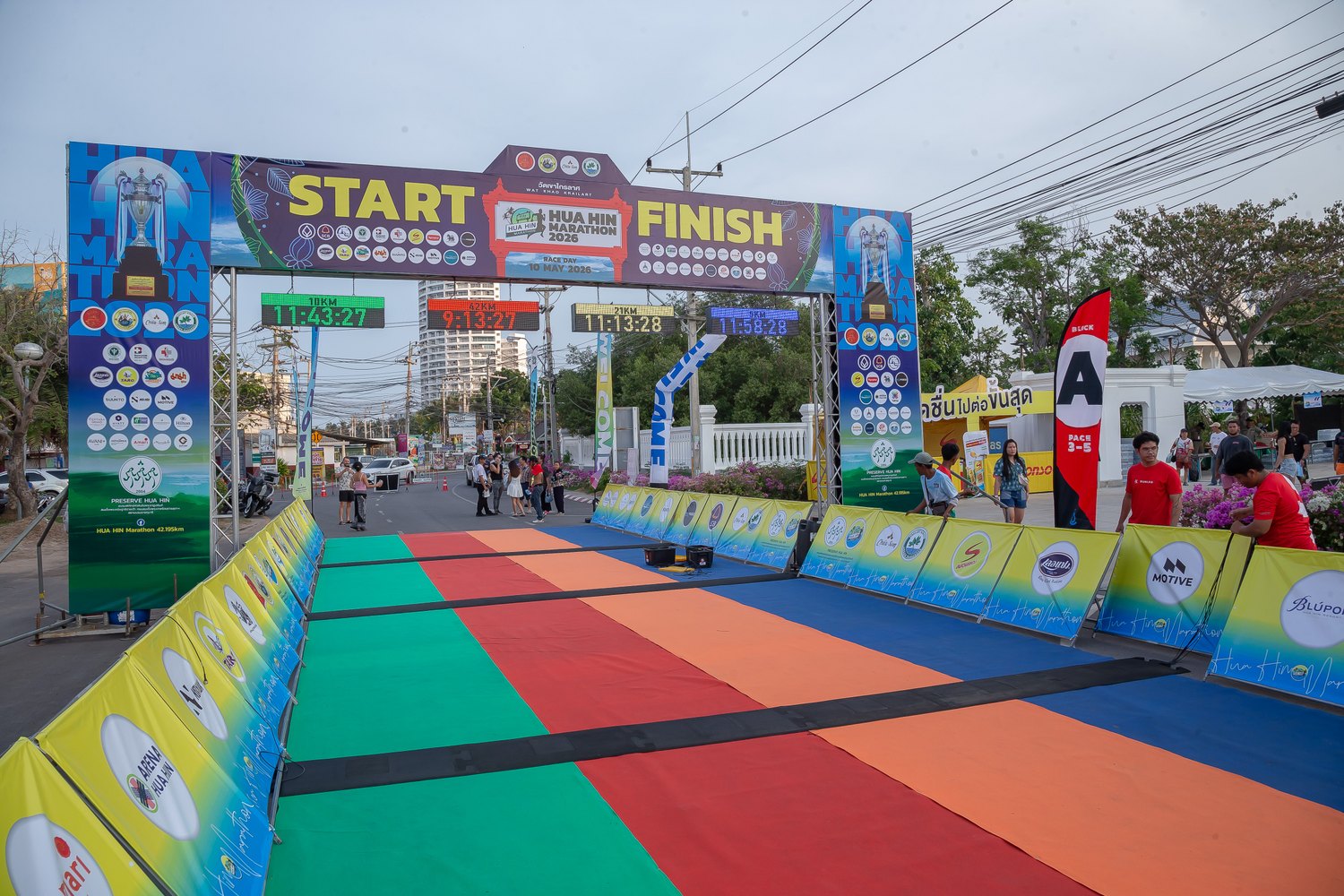
RFID timing
Times you can prove, and no corrections to chase afterwards
When several runners cross the line together, the hard part is knowing whose time is whose. And when someone disputes it after the race, can you prove it?
Hand timing puts one person on the stopwatch and another writing down bibs, matched up afterwards, and that slips easily when runners finish in a group. When a runner says the time does not match their watch, the organizer has only numbers the crew typed, so the correction usually gets made as asked and other runners’ placings move with it.
RunLah’s crew has RFID-timed more than 270 events. Every recorded time has a per-read record you can open, and finish-line video is there when an issue comes up, so you answer questions with evidence, in time for the prize ceremony.
What this service does for you
- 1
Timing points planned alongside the course
The timing crew works with you while the course is being planned: how many points, which kilometre each one sits at, and which distances share them. Points with dense traffic or where a miss cannot be tolerated get several receiver sets stacked at the same location, not just one.
- 2
Bibs, chips and the database are finished before race day
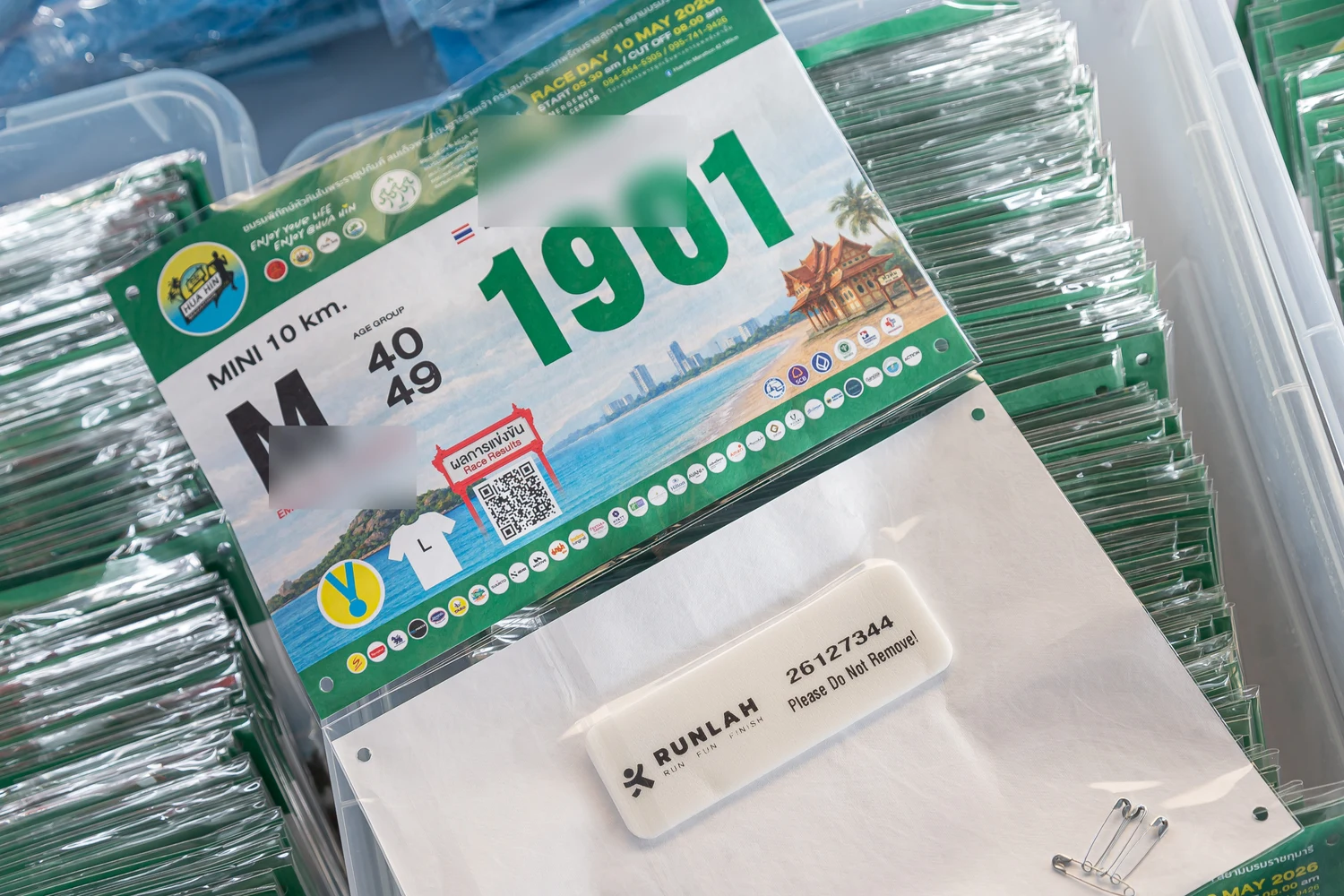
Bib numbers for the whole event are prepared in advance, every bib comes with its timing chip already fitted and paired to that bib number in the database one by one, and the set is checked for anything missing or paired twice. You receive bibs that are ready to hand out, with no chip work left to do at the venue. Events wanting extra certainty can have two chips per bib.
- 3
The crew installs every point ahead of time
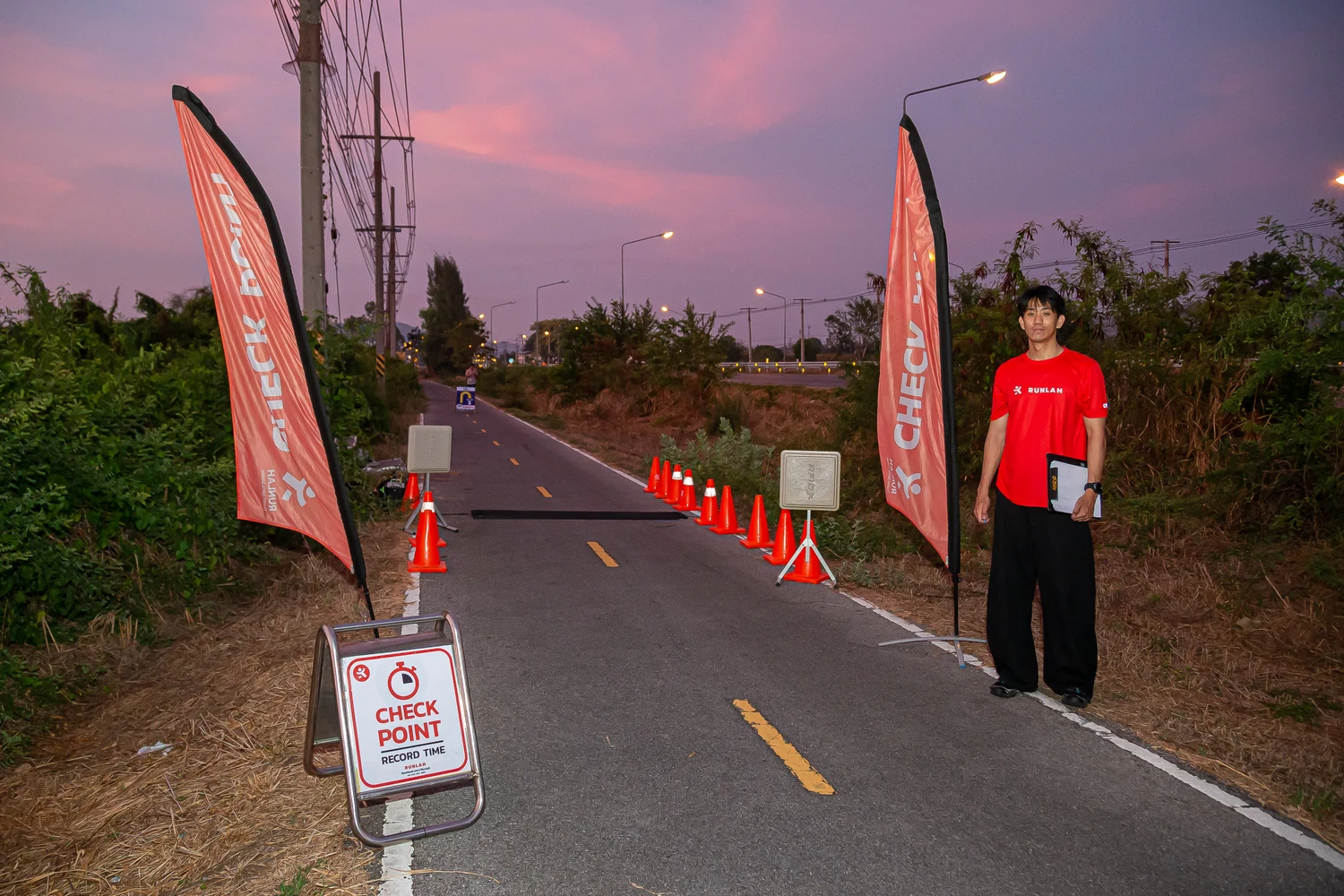
Start, finish and every checkpoint in between are installed before the gun: timing mats, receiver poles, reader boxes, batteries, point signage and the finish-line video camera are all our equipment and installed by us, then tested to prove every point reads before the first runner arrives. All you provide is a spot the vehicle can reach — and none of your own people have to be stationed at any of them.
- 4
Times flow in while runners are still on course
Each time someone passes a point, that time enters the system immediately — no waiting to collect the equipment and download from it. The crew can see who has reached which point, who has not made a cut-off, and where something looks wrong, while there is still time to act on it.
- 5
Results appear at the line, on the venue screen and in runners’ hands
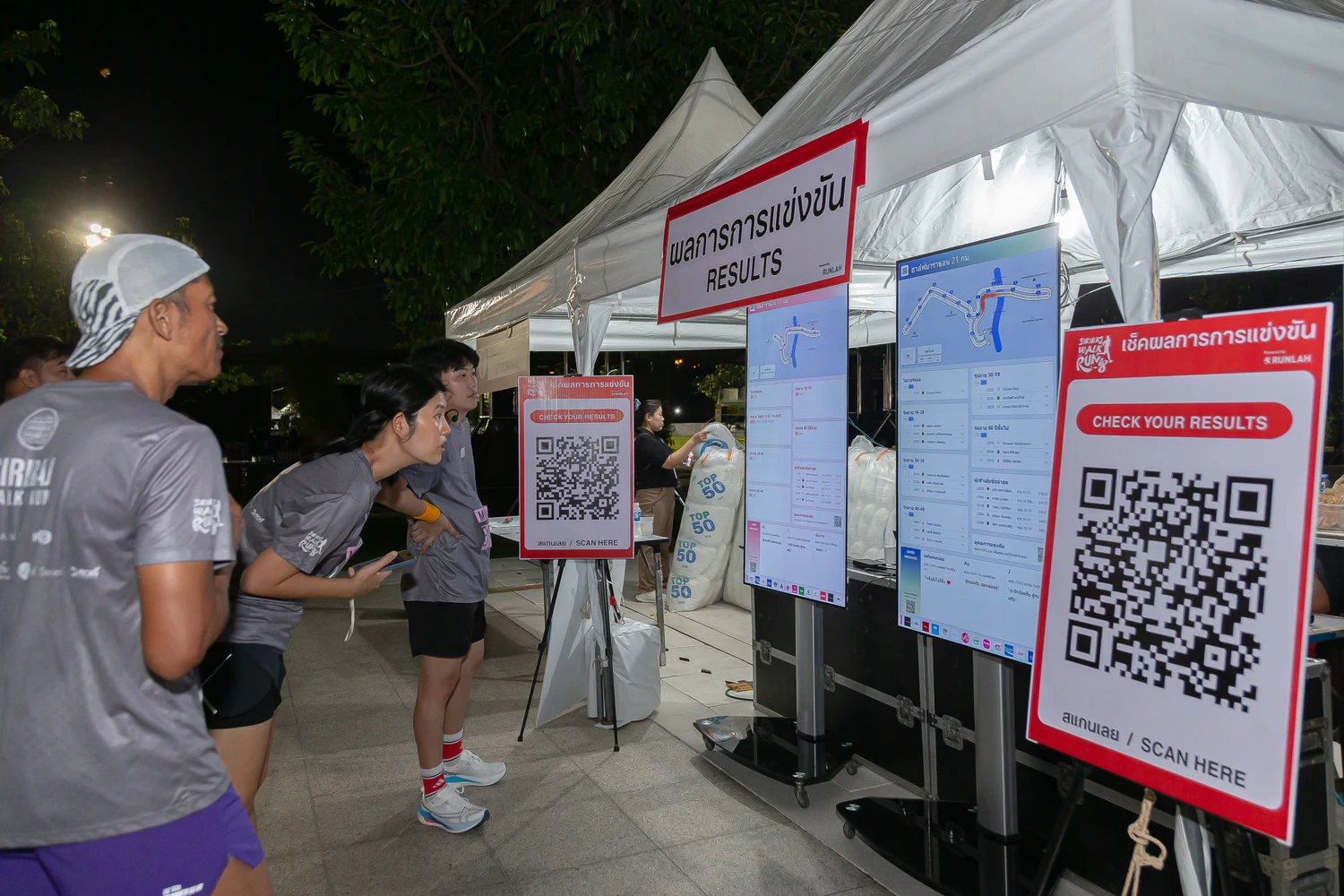
Total time, splits and category placing are calculated and appear simultaneously on the results screen at the venue and on the results page online. Runners scan a QR at the results point and look up their own name or bib immediately instead of queuing to ask, and your crew works from the same table — so the winners can be checked before names are called, rather than announced and checked afterwards.
- 6
When something is disputed, the finish video is right there
The finish-line camera records throughout as a backup to the chip times. It is not reviewed for every placing — it is opened when there is a reason: a formal protest, places separated by a fraction of a second, a chip that did not read at the line, or a doubt about whether the runner who came through owns that bib, for instance a gender that does not match the category entered. The crew opens it in a system RunLah built for the purpose, calling up that bib’s moment directly instead of scrubbing through two hours of footage — so matters that used to be parked get settled before the prize ceremony.

How organizers use it
Times at every point, not just the finish
Intermediate points tell you who is still out on course and where they are, so cut-off decisions come from real data instead of guesswork, and finishing runners can be confirmed to have passed every point. And when a runner asks which section they slowed on, the answer is already on their own results page without anyone having to look it up.
Wave starts that stay fair to everyone
Every runner gets both a time from the start signal and a time from when they actually crossed the start line, so events starting in waves or by category do not have to choose. You decide which of the two settles the overall placing, the category placing and each individual prize — and they can differ within the same event.
A live leaderboard that means something before anyone finishes
During the race, runners are ranked first by the furthest point they have reached and only then by time, so someone past point 3 always sits above someone who has just passed point 2. The leaderboard on the screen and on the web is meaningful from early on, rather than sitting empty for two hours and filling all at once at the end.
One set of results, in every channel the venue needs
The same times appear everywhere at once: the result page runners open on their phone by scanning a QR, the TV screen showing live results and placings, the slip printing point handing out a paper result to take home, and the A4 lists your crew prints for the reporting desk and the prize stage. All of them read from the same data, so two channels cannot disagree about a placing.
Answer questions with evidence instead of concessions
Every chip read is stored — the time, the point, which pole read it and the signal strength — so you can look up an individual and see exactly which points they passed and when. Questions that used to end in a correction simply because nothing could be proven now have a clear answer within minutes. And if a recorded time really is wrong, it can be corrected with a record of who changed it.
Prizes settled from footage, not from what someone remembers
When a placing is protested, or there is doubt that the person who finished owns the bib, you already hold both the finish video and the per-read chip history. Nothing has to be decided from the memory of whoever was standing there, or by conceding to whoever argues loudest. And because it can be checked quickly, the answer arrives before the ceremony — the only moment when fixing it does not mean asking for a trophy back.
Missing times can be recovered, not apologised for
A backup receiver set at the same point is used automatically when the primary has no reading for someone. Points still missing can be filled from the finish video or from neighbouring points before results are published. And afterwards it is still possible to separate runners whose chip genuinely did not read from readings the configuration discarded — two problems with different fixes, and knowing which one you had is what actually makes the next event better.
No separate timing company to find and coordinate
The equipment, the crew at each point and all the configuration come with the service, so there is no timing provider to contract separately and then coordinate with about how the results file gets handed over. The results flow straight into the results page, certificates, result slips and the venue screens, which are already the same system.
What you can set
- Who configures it
- RunLah’s timing crew configures everything before race day; you review it and tell us about any changes — there is nothing for you to set
- Timing points per distance
- No limit. Choose which kilometres each distance is timed at, and let several distances share the same point
- Starts
- A mass start per distance, or waves and per-category starts where each group has its own start time
- Ranking mode
- Use the time from the start signal or from crossing the start line, set separately for the overall placing, category placing, age-group placing and individual prizes
- Prizes
- Unlimited prizes at category and age-group level, with the number awarded and the number of reserves, and a rule preventing one runner from taking a second prize
- Per-runner status
- Mark individuals as did not start, did not finish or disqualified — including disqualification from a particular prize while remaining in the overall results
- Untimed distances
- Walks and fun runs can be set as distances with no results, so they need no chips and do not appear on the results page
Frequently asked questions
What does the organizer need to provide?
Somewhere to set up each timing point that a vehicle can reach and where equipment can stand, plus entrant data settled enough for chips to be paired before race day. Equipment, chips and the crew at each point are all ours. Internet at the timing points is not required: points in areas with no signal still time normally, because readings are stored on the device and sent up once signal returns — the only difference is that those results appear later than points with constant coverage.
What happens if someone’s chip does not read at a point?
Every point that did read is stored, so the crew can see who is missing which point, and points with a backup receiver set fall back to it automatically. Points still missing can be filled from the finish video or from neighbouring points before results are published. A missing intermediate point does not take the total time with it, because the next point is calculated against the previous point that was actually recorded, not the one that comes next in sequence.
How quickly do results come out?
Times reach the system within seconds of a runner passing a point, and the results page and leaderboard update immediately. Results treated as official should be checked by the crew first, particularly the list of prize winners — which takes a few minutes per category, not a wait for the whole event to be processed.
What kind of chips are they, and do we collect them back?
Disposable chips fitted to the back of the bib, so there is no return point to staff and no deposit to handle. Runners do nothing with the chip beyond wearing the bib on the front as usual. Events wanting extra certainty can have two chips per bib, a further backup on top of the receiver sets already stacked at each point.
Do you support wave starts, multi-lap courses or multi-day events?
All of them. Start times can be set per category or per wave. A course that passes the same spot several times is configured as multiple timing points at different cumulative distances, so the system knows which lap a read belongs to. And events sharing a start and finish line can separate start times from finish times without confusion.
If a runner says the time does not match their own watch, what do we tell them?
You can open that individual immediately and see how many times the chip was read, at which points, at what times, and which read was used as the time for that point. Most differences come from the runner starting or stopping their own watch before or after actually crossing the line, which this data explains directly. If the time the system chose really is wrong, it can be corrected with a record of what was changed and by whom, and the affected placings are recalculated automatically.
Is there finish-line video, and when is it used?
Yes — our crew sets up a camera at the finish as a backup to the chip times, so you do not have to arrange a camera or an operator. It records throughout but is not reviewed for every placing, because the chip time settles things normally. It is opened when there is a reason: a formal protest, someone reporting that a placing does not match what they saw, a chip that did not read at the line, or a doubt about whether the finisher owns the bib, such as a gender that does not match the category entered.
How many timing points should we have?
It depends on the distance and what you want the results to tell you. The minimum is start and finish. From the half marathon upwards, at least one intermediate point usually pays for itself: it shows who is still on course, it is evidence that a runner covered the route, and it is the part runners most enjoy looking at on their own results page. The timing crew will propose a layout when the course is discussed anyway.
Where do the results live afterwards?
Permanently on the event’s results page, searchable by name or bib, with a shareable individual result page for each runner. It is the same data used by certificates, result slips and post-event statistics, so you never receive a results file that then has to be handed on to somebody else.
Related services
Chip check
A verification point after pack collection: tap the bib on the reader and the runner’s name, distance and age group appear on a large screen for them to check themselves. Anything wrong is corrected on the spot — and it is a screen runners want to be photographed next to.
Results & rankings
Results appear the moment a runner crosses the line, with splits and category rankings across every distance, plus an individual result page that can be shared and looked up long afterwards.
Live display for TV / OBS
Live results, placings, latest finishers and sponsor logos appear on screen straight from the times being recorded — as TV screens around the venue, and as a transparent overlay your own stream team can drop over their live video.