
e-Certificate
Runners download their own, with nothing to print or hand out
Runners genuinely want a certificate, but each one carries a name and a time, so it cannot be prepared in advance like a medal or a shirt. It turns into a big job after the race.
Paper means writing times in by hand, or running a printing point and adding one more long queue. Files mean someone placing a thousand names one at a time and sending each back to its owner. Either way it tends to arrive late, and the runner who meant to post it on race evening never does.
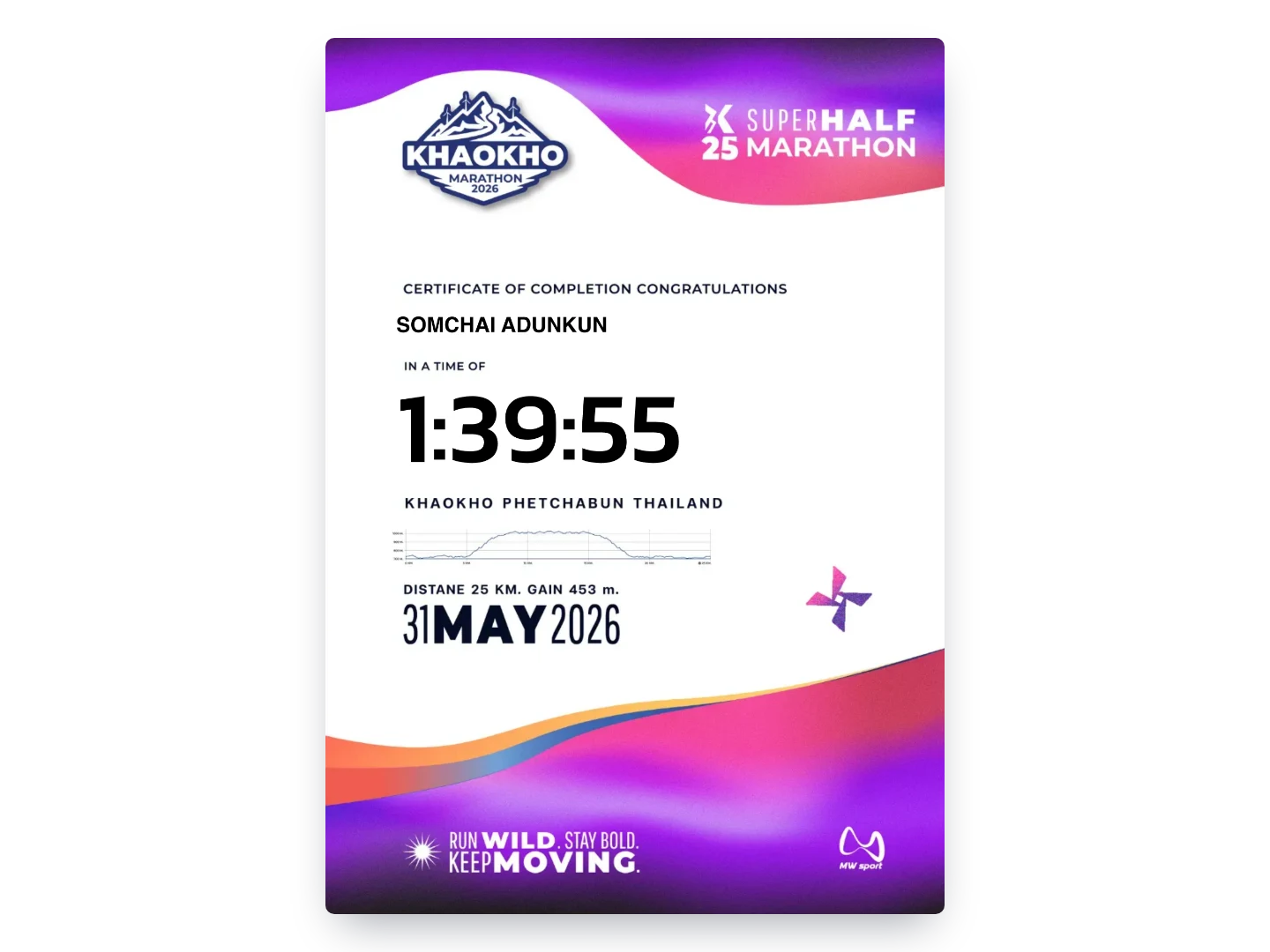
At events we time, finishers download a certificate with their own name and time from their results page straight away, on your event’s design: our team lays out the fields and you check a real sample before approving.
What this service does for you
- 1
Your certificate design is ready before race day
You send us the event’s artwork and the RunLah team places the fields for name, time and anything else you want onto it, then you check a real sample before approving. What runners receive is your event’s design in full, not a generic template every race shares.
- 2
Downloadable from their own result page as soon as they finish
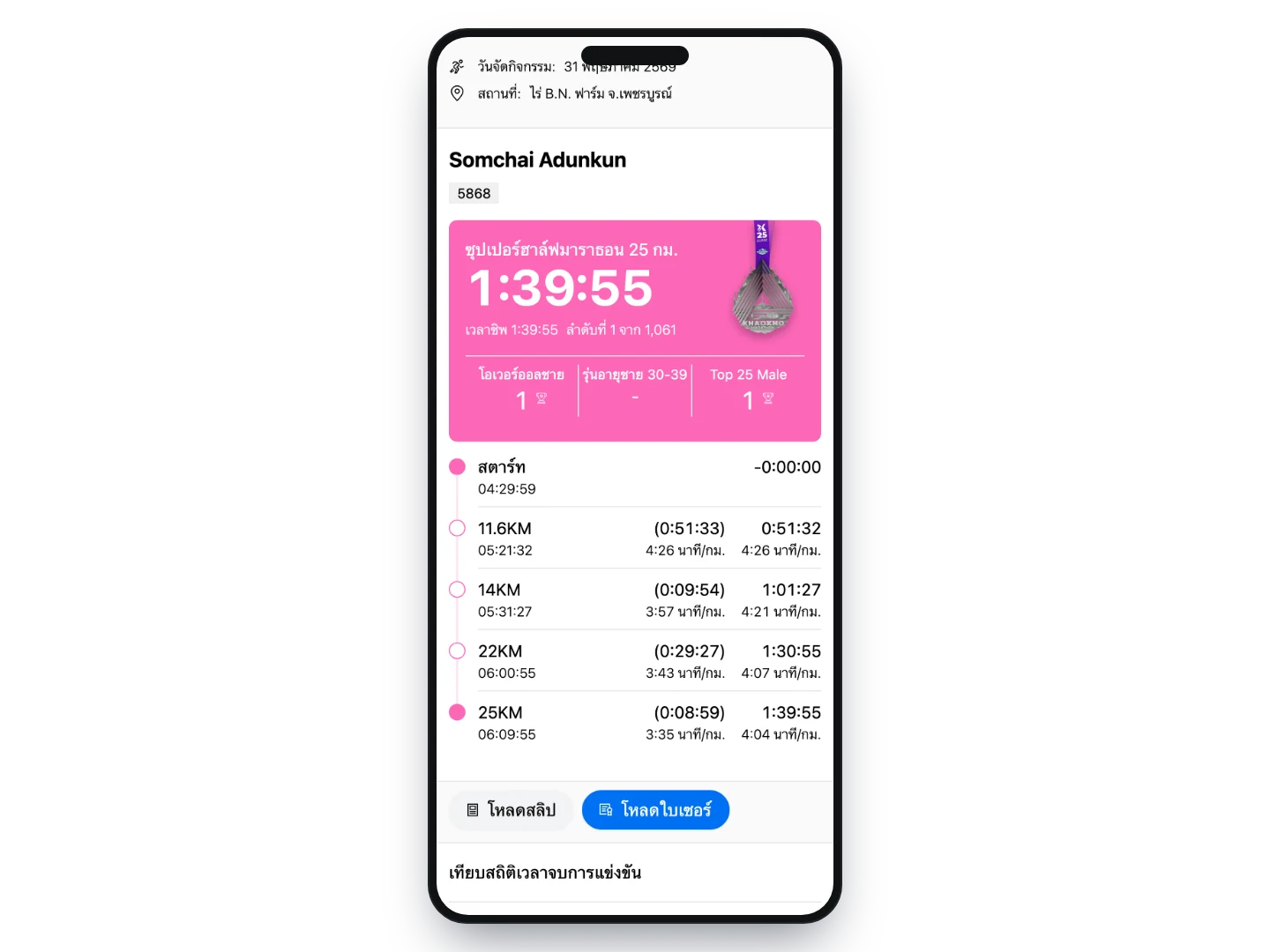
No waiting for an announcement and no distribution round. A runner who has finished opens their own result page and the download button is right there — no login, no form to fill in, and no waiting for someone to send them a link.
- 3
Each certificate belongs to that runner
Their name, bib number, distance, age group, total time, chip time and placing are drawn onto your design at the moment of download. The file saves straight to the device, on a phone or a computer, ready to post or to print later.
- 4
A QR that leads back to the real result
You can include a QR pointing back to that bib’s result page, so anyone looking at the certificate can see the splits and placings the system recorded. It is not just a nice image — it can be traced back to a real event.
- 5
If the result changes, so does the certificate
When a result is corrected after the event, anyone downloading afterwards gets the correct certificate, because it is generated from the latest result every time. There is no folder of stale files to clean up and no wrong version sitting on a link you already sent.
How organizers use it
The cost and the after-work disappear together
No paper, no printing point, no queue, no leftover pile from people who never collected, and no envelopes to post. How many people download makes no difference to your costs — unlike every other giveaway, which has to be estimated in advance.
Delivered while they still want to show it off
Runners have it before they leave the venue, which is when posting peaks. A certificate carrying their name and your event’s branding becomes media they publish for you, rather than a file arriving once the moment has passed.
Nobody misses out and nobody has to chase
Everyone who finishes has one waiting on their result page — whether they left early, ran their battery flat or only remembered at home. There is nobody on your side answering questions about where the certificates are.
Lost the file? Download it again, as often as needed
It is not sent once and gone; it is regenerated on every download. A runner who deleted it, changed phones or wants another copy to print can come back and get one without asking anybody to make it again.
International runners get their name spelled correctly
The name on the certificate is the one entered at registration, so anyone using the English site gets their name in Roman script rather than a transliteration somebody at the desk guessed at.
People come back to your event’s pages
The only way to the certificate is through their own result page — which carries your event name, their placing and a link to next year’s edition. The event gets visitors back after it is over, instead of ending at a single email attachment.
What you can set
- Which distances get certificates
- Enabled per distance — all of them or only some
- How it looks
- Your event artwork fills the certificate, including the event and sponsor logos on that design, at whatever size and proportions you choose
- What is printed on it
- Name · bib number · distance · age group · total time · chip time · splits and section paces · overall and category placing · prize won — pick which of these appear and where
- QR code
- Optional; when included it points back to that bib’s result page online
Frequently asked questions
Do runners have to log in or fill anything in to download?
No. The per-bib result page is public, and tapping the button saves the file to the device immediately. No email address or phone number is asked for first.
Do runners who did not finish get a certificate?
No — the button appears only for runners with a recorded time at the final point, which is deliberate, since a certificate attests to having finished. They can still see whatever the system recorded on their own result page as usual.
What format is the file, and can it be printed?
An image at the size set when the design was laid out. If that size is generous enough for A4, it can be printed at a shop. It is not a PDF, so if you intend runners to print and frame it, mention that at design time and we will set the dimensions accordingly.
Can placings or prizes be printed on it?
Yes — overall placing, age-group placing and the prize won, as well as splits with the pace for each section. Events wanting the winners’ certificates to look different from the rest can arrange that at design time.
Does the system email the certificate?
Not as a file. Runners download it from their result page, but the thank-you email after the event has a button back to their own result — which is how most people come back to download it.
How long does the certificate stay available?
As long as the event’s results page exists, which has no deletion date. Runners can come back and download again at any time, and each download is generated from the latest result.
What if a result is corrected after people have downloaded?
A file already saved on a runner’s device cannot change — it is theirs. Everything downloaded afterwards is correct, so nobody has to chase the whole field to download again.
Can events timed by another provider use this?
Not currently, because the certificate is generated from that bib’s result in RunLah’s system at the moment of download — name, distance, age group and time. Events timed elsewhere have no per-bib result page for the download button to live on.
How much of the design is up to the organizer?
The entire background is your artwork — logos, colours, graphics, sponsor space, however you want it. The RunLah team places the name and time fields onto it and sends you a real sample to check first, so you do not discover on race day that a long name runs outside its box.
Related services
Results & rankings
Results appear the moment a runner crosses the line, with splits and category rankings across every distance, plus an individual result page that can be shared and looked up long afterwards.
Ratings & surveys (NPS)
A thank-you email brings runners back to their results, their photos and a rating form, which becomes a score per category you can compare across distances and across years.